

Orbital Compute: Why the World's Biggest Tech Companies Are Moving AI to Space
AI is breaking the physical world. The grid can't keep up, the land isn't there, and the water is running out. Now, the most serious people in technology are proposing the most audacious fix: put the computers in space.
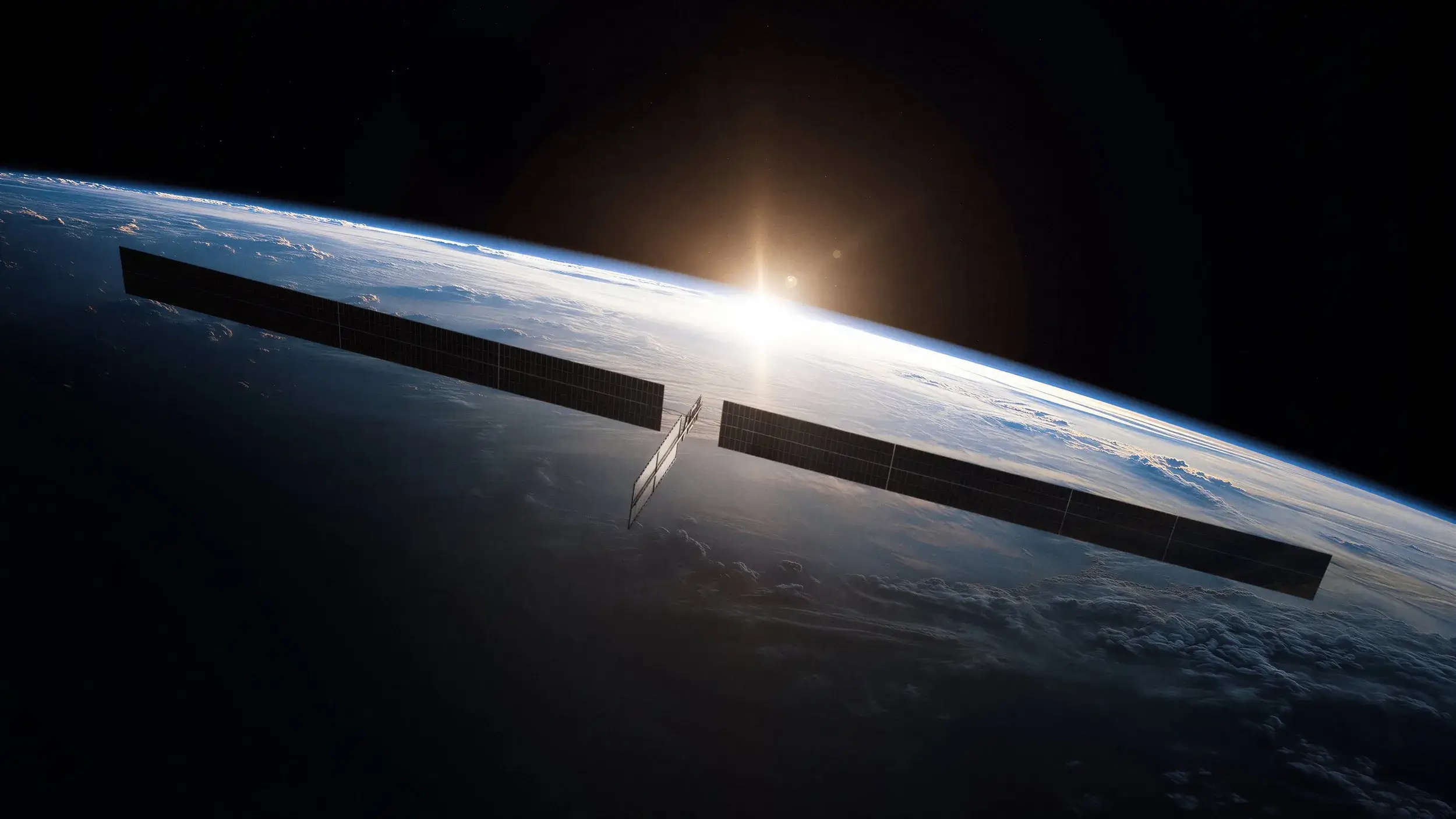
AI is breaking the physical world. Not metaphorically. Literally. The grid can't keep up. The land isn't there. The water is running out. And now, the most serious people in technology are proposing the most audacious fix imaginable: put the computers in space. This is not science fiction. This is happening right now, and the timeline is measured in months, not decades.
Why the ground is failing us
Electricity demand from data centers soared 17% in 2025, and AI-focused data centers climbed even faster, well outpacing global electricity demand growth of 3%. The IEA now projects that data center electricity consumption is set to more than double to around 945 TWh by 2030, roughly equivalent to Japan's total electricity consumption today.
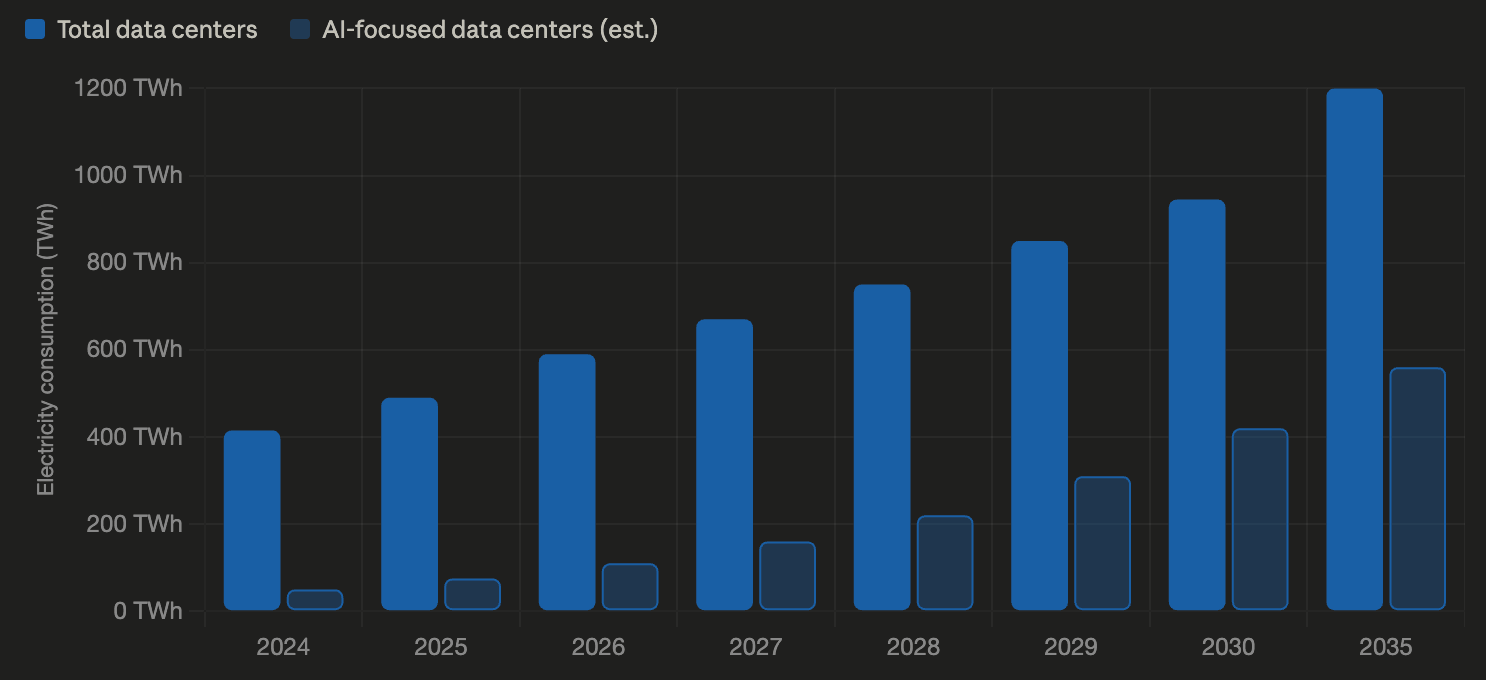
A typical AI-focused hyperscaler consumes as much electricity annually as 100,000 households. The larger ones currently under construction are expected to consume 20 times as much. And the grid cannot grow fast enough. Gross positive grid reliability headroom across US ISO territories stood at roughly 18.3 GW in 2025, down from 70.2 GW in 2021.
Power is only half the constraint. Water, land, permitting, and cooling infrastructure are all binding. A data center can be built in two to three years, but securing the power to run it can take a decade. Something has to give.
The orbital thesis
The logic is simple: space has none of these constraints.
Solar panels in low Earth orbit receive power 24 hours a day with no clouds, no atmosphere, and no nighttime losses. Waste heat can be radiated directly into the vacuum. There's no land to acquire, no water to consume, no utility grid to petition.
Space data centers would be equipped with solar-panel-equipped satellites designed to harness power directly from the sun, offset heat into space, and not be limited by available land.
The race to get there is now fully underway, with three distinct bets on the table.
Bet 1: SpaceX's AI1 satellite
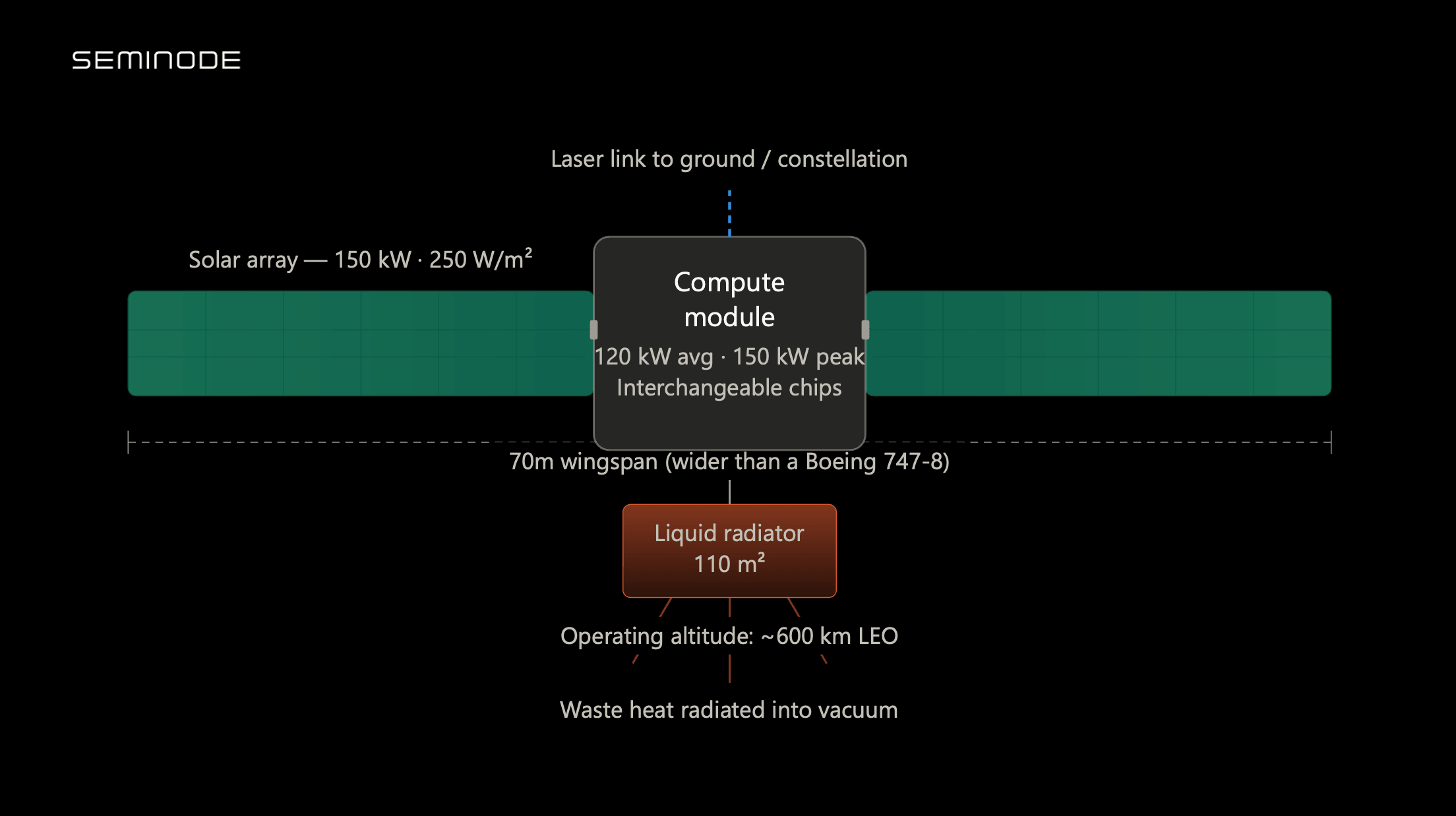
Musk compared the power draw to a single Nvidia GB300 rack, which is rated at 140 kW. Each AI1 satellite is essentially one AI server rack in orbit, wrapped in solar arrays, radiators, communications systems, propulsion, shielding, and enough structure to survive launch and years of vacuum exposure.
That framing is deliberate. A single satellite isn't impressive. The math of scale is. Starship can carry 30 to 50 AI1 satellites per launch. A single Starship flight therefore delivers the compute equivalent of 30 to 50 GB300 racks, instantly, with no land acquisition, no power grid approval, no cooling infrastructure build-out.
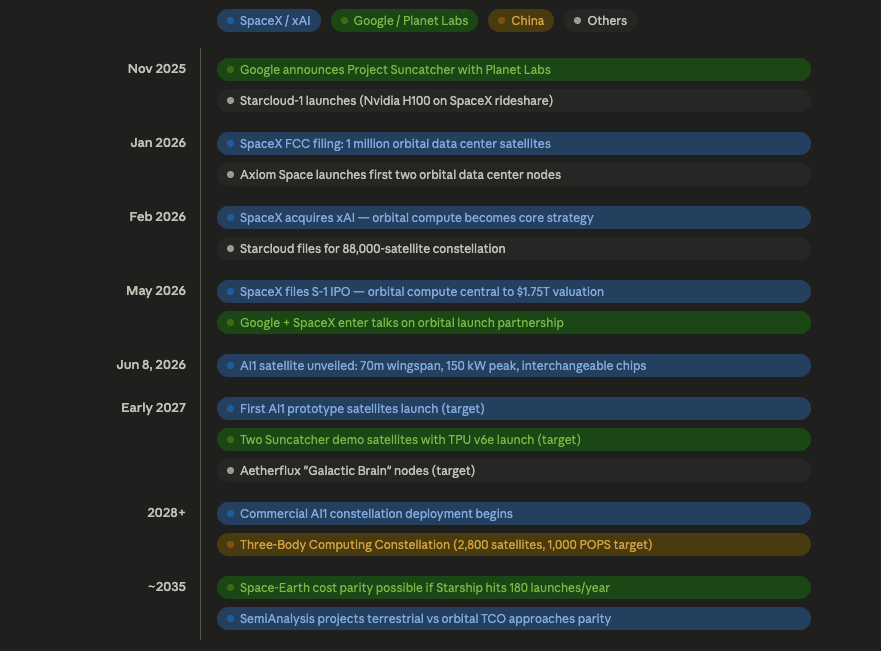
SpaceX is targeting one gigawatt of orbital AI compute by the end of 2026, scaling to 100 gigawatts within three and a half years. Their S-1 IPO filing, submitted May 20, 2026, puts it plainly: "Our goal over time is to launch 100 gigawatts of compute to space each year."
The chip supply to do this doesn't exist yet, which is why SpaceX also announced Terafab, a proposed chip manufacturing facility in Grimes County, Texas. Compute allocation splits 80% space and 20% terrestrial, roughly 800 GW for orbital data centers and 100 to 200 GW for terrestrial inference.
Bet 2: Google's Project Suncatcher with Planet Labs
Google is taking a more measured, scientifically grounded approach. Project Suncatcher, formally announced by CEO Sundar Pichai in late 2025, aims to deploy a constellation of solar-powered satellites equipped with Google's custom Tensor Processing Units. Google has partnered with Planet Labs to design and launch two prototype satellites by early 2027. These test units will serve as a proof-of-concept for a potential 81-satellite cluster that uses laser-based communication to share massive AI workloads across the constellation.
Google's radiation testing confirmed the TPU v6e can withstand radiation levels across a five-year low-Earth orbit mission. Lab demonstrations achieved 1.6 terabits per second using a single transceiver pair.
The economics Google has modeled are revealing. Given an estimated US data center power cost of approximately $570 to $3,000 per kW per year, Google said that if launch costs to LEO reach $200 per kilogram, the cost of launch amortized over spacecraft lifetime could be roughly comparable to data center energy costs on a per-kW basis. This launch cost could be reached in 2035, Google theorized, should Starship launch soon and then launch 180 times per year.
That is a conditional bet on SpaceX's success, which is why Google and SpaceX are reportedly in active talks to launch orbital data centers together.
Bet 3: The rest of the field
This isn't a two-player game. Multiple competitors including Starcloud (backed by NVIDIA), Google's Project Suncatcher, SpaceX's Starlink V3, and the European ASCEND initiative are racing to establish orbital computing presence.
In May 2025, China launched the first dozen satellites of its planned 2,800 satellite constellation known as the Three-Body Computing Constellation. Planned to be a supercomputer in space, each of the dozen satellites will be linked by laser communications. The entire constellation, once completed, will be capable of completing 1,000 peta operations per second.
Startups are also entering the field. Starcloud launched its first satellite on a SpaceX rideshare mission in November to test running AI models on an Nvidia processor in orbit. Aetherflux, a company developing space-based solar power systems, announced plans to deploy orbital data center nodes it calls "Galactic Brain," with initial launches targeted for 2027.
What actually has to be solved
Orbital compute is not a free lunch. The honest version of the argument acknowledges three real hard problems.
Cooling. There is no air or water in space. Heat leaves only one way: thermal radiation. The International Space Station's thermal system rejects roughly 70 kW of heat across 422 square meters of radiator. AI1's 110 square meter radiator has to handle roughly the same load at a fraction of the area, relying on advanced liquid cooling loops and materials science that doesn't fully exist yet.
Cost. In the base case scenario, the cost difference between space and terrestrial data centers starts at over 4x in 2026, before narrowing to parity around 2040. The orbital thesis only works at scale, and scale requires Starship to fly at an unprecedented cadence.
Radiation. Cosmic rays and solar energetic particles damage chips over time. Google's radiation testing on the TPU v6e provides early validation, but running a data center for five or more years in LEO requires hardened hardware designs the industry is still developing.
None of these are fatal objections. They're engineering problems with engineering solutions. The question is whether the terrestrial constraints are getting bad enough, fast enough, to justify the investment.
Given that the capital expenditure of five large technology companies surged to more than $400 billion in 2025 and is set to increase by a further 75% in 2026, the answer appears to be yes.
What this means for the supply chain
For those of us in electronics manufacturing, this is a procurement and logistics story as much as it is a computing story.
Every AI1 satellite is a dense electronics package. Solar cells, compute modules, radiators, laser transceivers, propulsion, shielding. SpaceX's stated goal is a constellation of a million satellites, each generating about 100 kW of compute power per ton. A million satellites, manufactured at scale, is an electronics procurement event unlike anything the industry has seen.
The EMS companies building those satellites will face parts availability windows measured in weeks, not quarters. The distributors and brokers supplying them will need real-time visibility into what is available, where, and at what price. The margin for error shrinks when a launch window is fixed and a satellite has a five-year operational life.
The orbital data center is not just a new customer for the cloud. It is a new customer for every tier of the electronics supply chain. And it is coming faster than almost anyone expected.
Sources: SpaceX S-1 filing (May 2026), IEA Energy and AI report, IEA Key Questions on Energy and AI (April 2026), SemiAnalysis "To Boldly Go: The Case for Space Datacenters" (June 2026), SpaceNews, Data Center Dynamics, TechCrunch, Interesting Engineering, Astronomy.com, Pew Research.
Get the next one in your feed
Industry analysis on electronics supply chains, procurement, and the infrastructure behind global trade. New posts delivered through LinkedIn.