

The Case Against Supply Chain Portals
Every OEM, CM/EMS, and distributor built their own supplier portal. The result? Fragmentation, not efficiency. Why open protocols like OMA are the future of electronics supply chain infrastructure.
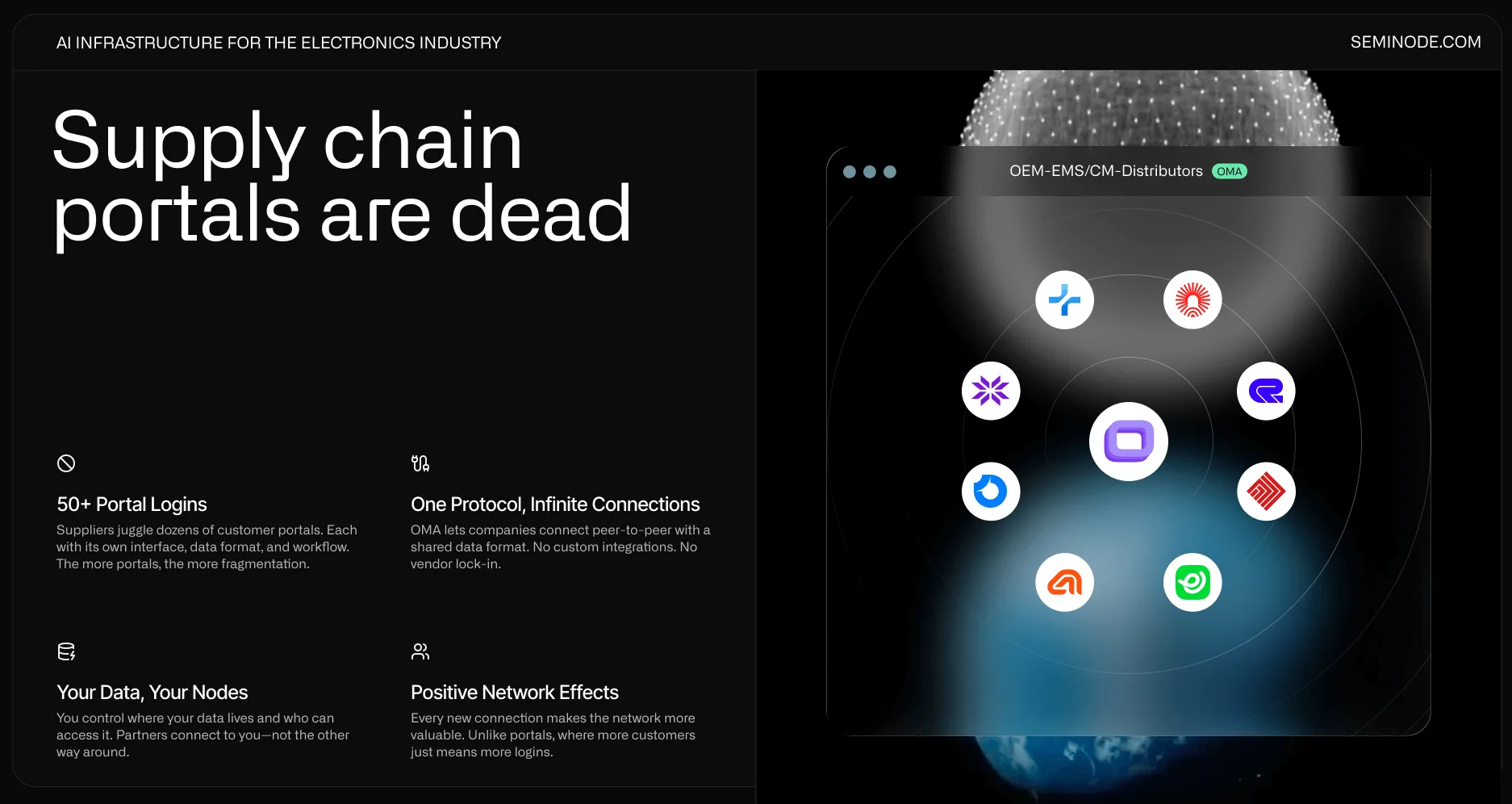
The Problem
Ask any supplier sales rep how many customer portals they log into. Thirty. Fifty. Sometimes over a hundred.
Each portal has its own login, its own interface, its own quirks. Upload inventory here. Check RFQs there. Respond to quotes in this format. Repeat across every major customer.
Every large OEM, distributor, and contract manufacturer built their own supplier portal. Each one optimized for their procurement process. But from the supplier's perspective, the party that has to use all these systems, it's a nightmare.
The portal model doesn't scale. The more companies that build portals, the more fragmented the ecosystem gets. You can't solve a structural problem with better execution.
What If Portals Are the Wrong Model?
Think about how the internet evolved. Early on, there were competing proprietary networks: CompuServe, Prodigy, AOL. Each was a walled garden. Then open protocols won.
TCP/IP, HTTP, SMTP. Shared standards anyone could build on. Once the world adopted them, the walled gardens collapsed. Everyone could communicate with everyone.
The electronics supply chain is still stuck in the AOL era. Every company building their own walled garden, wondering why the system remains fragmented.
The answer isn't a better portal. It's an open protocol.
OMA: Open Materials Availability
Open Materials Availability (OMA) is an open specification for exchanging material availability, quotes, and orders between trading partners. No central authority required.
Instead of "suppliers log into our portal," OMA enables companies to connect directly, peer-to-peer, using a shared data format. The core models: Listings (supply/demand), Quotes, and Quote Responses.
Each company runs their own nodes. You control who sees your data. But because everyone speaks the same protocol, connecting to a new partner doesn't require a new integration.
One protocol. Infinite connections.
Seminode: Electronics Supply Chain Infrastructure
Seminode is electronics supply chain infrastructure built on OMA:
- Nodes you control: Create nodes for excess inventory, shortages, purchase requisitions. Your data lives in your nodes.
- Real-time network feed: Live feed from all connected partners instead of logging into fifty portals.
- Structured quoting: Centralized inbox with clear status tracking. No more scattered email threads.
- Partner management: Build your own private network that grows more valuable with every connection.
- Email integration: Connect with Outlook and Gmail to work with partners the way you already do. No workflow disruption.
The key difference: you're not asking partners to come to your system. You're connecting to a shared network where everyone maintains their own presence.
Portal vs. Protocol
| Portal Model | OMA / Seminode |
|---|---|
| Supplier logs into your system | You connect to supplier's node |
| N integrations for N partners | One protocol for all partners |
| Batch updates, stale data | Real-time streaming |
| More customers = more logins | More connections = more value |
Portals have negative network effects for suppliers. Every new customer portal makes life worse. OMA has positive network effects. Every new participant makes the network more valuable for everyone.
Why Now?
AI works better with structured data. You can automate electronics procurement with spreadsheets and emails, but it's brittle, expensive, and doesn't scale. OMA provides the standardized data layer that makes AI-powered automation reliable.
The 2020-2022 semiconductor shortage exposed the cracks. Electronics companies discovered they had no real-time visibility into supplier inventory. "Digital transformation" was a thin veneer over emails and spreadsheets.
The cost of fragmentation now exceeds the cost of change. Procurement teams spending 60% of time on data entry. Millions in excess inventory that can't find buyers. The status quo is no longer cheaper.
The Choice
You can keep building portals. Suppliers will keep juggling logins. Data will stay siloed.
Or you can build on shared electronics supply chain infrastructure. Your data stays yours but speaks a common language. Every new connection strengthens the network instead of fragmenting it.
The companies that built on open internet protocols in the 1990s didn't get better AOL. They got something fundamentally different.
The electronics supply chain is ready for that same transition.
Learn more about OMA at docs.seminode.com/oma/specification
Get started with Seminode at docs.seminode.com/quickstart
See how a network differs from a portal: the electronics supply chain network
Get the next one in your feed
Industry analysis on electronics supply chains, procurement, and the infrastructure behind global trade. New posts delivered through LinkedIn.